
You know that nasty little drop in your stomach after saying something completely normal, and then your brain decides to replay it for the next six hours as if you had licked a bus window in public? Yeah. Toxic shame often feels exactly like that. Not, "Well, that was awkward." More like, "There is something fundamentally off about me, and now everyone has noticed."
When that pattern is humming along in the background, growth gets absurdly expensive. You hide. You overperform. You apologize for taking up oxygen. And somehow, even after all that effort, you still feel one weird glance away from being exposed. If that feels... uncomfortably familiar, stay with me. This knot can loosen. Slowly, yes. But really.
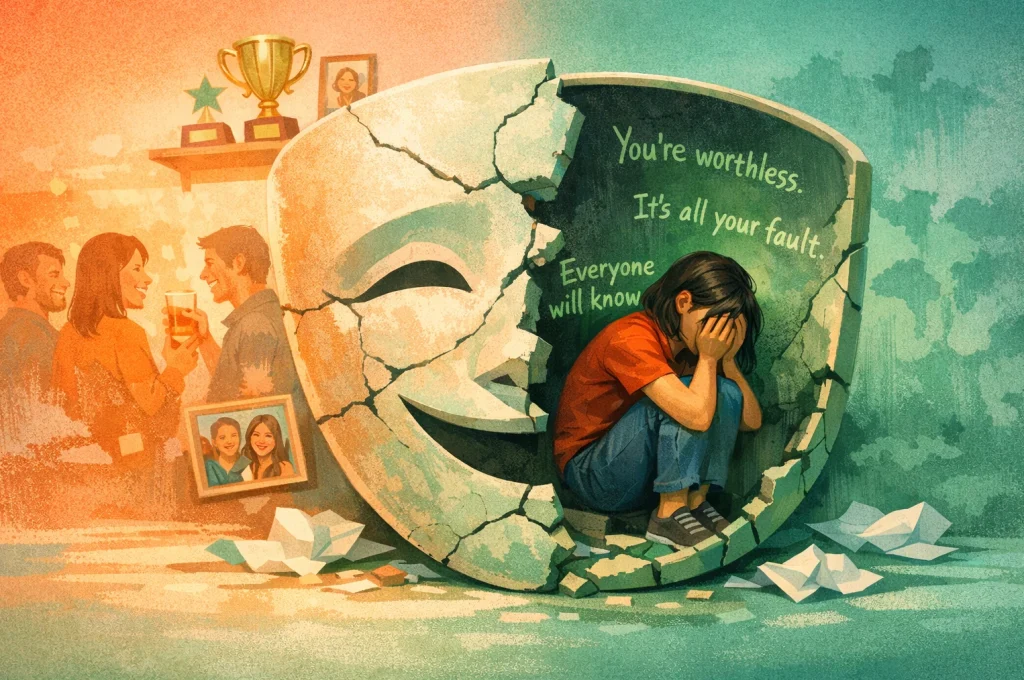
Table of contents:
Toxic Shame: when the problem feels like you
It sticks to identity, not just behavior
Toxic shame is not the ordinary sting of embarrassment. Healthy shame says, "Oof, that was clumsy. Fix it." Toxic shame says, "No, no - you are the clumsy one. You are the problem." That is the whole trick of it. One points to behavior. The other glues the moment to your identity like wet cement.
So people with toxic shame do not just regret mistakes. They feel stained by them. A missed deadline becomes proof that they are useless. Needing help becomes evidence of weakness. One bad date suddenly feels like a full audit of their worth as a human being. A bit dramatic? Sure. Also extremely common, which is somehow both comforting and bleak.
It wears all sorts of costumes
This is where it gets sneaky. Toxic shame rarely walks in wearing a little badge that says, "Hi, I am toxic shame." It shows up dressed as people-pleasing, perfectionism, hiding, defensiveness, overexplaining, or that breezy "I don't care" act that fools almost nobody. Some people go quiet and fold in on themselves. Others build a whole shiny personality on top of the bruise: funny, useful, hyper-competent, impossible to disappoint. Different costume, same engine.
Underneath, the nervous system is trying to avoid exposure. That is the whole game. If you often think, "Once they really know me, it's over," that is not humility. That is shame, whispering like a tiny prosecutor in the back of your head.
It usually grows in old emotional weather
This pattern usually does not appear out of nowhere. It tends to grow in homes, schools, friendships, churches, teams - anywhere love or belonging got tangled up with humiliation, contempt, chronic criticism, emotional neglect, or impossible standards. Sometimes the message was obvious: "What is wrong with you?" Lovely stuff. Sometimes it was quieter. You were praised only when useful. Mocked for normal needs. Treated like mistakes cost closeness.
So the child mind made a brutal little deal: if rejection keeps happening, maybe the safest explanation is that I am the bad thing. Kids do this because blaming themselves feels weirdly more manageable than admitting the grown-ups were unsafe, unfair, or emotionally unavailable. Painful logic. Very human, though.
It makes closeness feel risky
In adult life, toxic shame can bend almost everything out of shape: work, sex, conflict, rest, creativity, even joy. Compliments slide right off because they do not match the story already running inside. Feedback can feel like a knife fight when, in reality, it was one sentence in Slack. Intimacy gets messy too. You want to be seen, but being seen feels dangerous, so you perform, disappear, or keep one foot pointed toward the exit. Just in case.
That is why toxic shame is such a sneaky blocker. It does not just make you suffer. It makes you build a whole life around not being found out. Over time, that starts to look a lot like self-sabotage, but the point is slightly different: you are not simply making random bad choices, you are trying to stay safe from exposure. And once you see that, the pattern makes more sense. Not pleasant sense, but sense.
And yes, the body gets involved
Shame is not just an idea. The body joins the drama immediately. Eyes drop. Shoulders curl in. The face gets hot. The throat tightens. Some people freeze, some fawn, some laugh at exactly the wrong moment, some suddenly want to leave the room and become a houseplant. If you have ever felt physically smaller after one tiny social wobble, then yep, you know the flavor.
The body is basically saying, "Hide. Now." Which means healing toxic shame is not just about thinking prettier thoughts. It is also about teaching your body that being visible is survivable. Not always comfy. But survivable.
What life opens up when shame stops driving
Mistakes stop turning into verdicts
When toxic shame loosens its grip, failure shrinks back to normal size. A bad meeting becomes... a bad meeting. An awkward text is just an awkward text, not proof that you are socially doomed forever. Your brain stops dragging in the ancient choir that sings, "Behold! More evidence that you are fundamentally defective." Honestly, rude choir.
This change sounds small on paper. In real life, it is massive. You recover faster. You ask questions without feeling stripped bare. You can learn from correction because the lesson is no longer mixed with identity poison. And this is where actual growth gets possible. People change more easily when feedback does not feel like annihilation. It also becomes much easier to use problem-solving skills in a calm, useful way, because now you can ask, "What needs attention here?" instead of spiraling into, "What is wrong with me?"
Relationships get less performative
There is a quieter gift too: relationships become less like auditions. If toxic shame is running the show, you spend a strange amount of energy managing impressions, bracing for rejection, or trying to be endlessly easy to love. Exhausting. Kind of lonely, too.
Once that grip softens, honesty gets simpler. Not glamorous, maybe, but simpler. "That hurt." "I'm embarrassed." "I need reassurance." Real beats polished when closeness is the point. You also stop reading every delayed reply, tired tone, or mild disagreement as a grand referendum on your worth. Other people stop feeling like judges. They get to be regular flawed people again. Which is, frankly, a relief.
Ambition becomes cleaner
People carrying toxic shame often chase success in two wonky ways. They either avoid trying because exposure feels deadly, or they overwork because achievement is the only deodorant they have for self-contempt. Remove some shame, and ambition gets cleaner. Less frantic. Less haunted.
You can want things because they matter to you, not because you need a gold star taped over an old wound. That changes work more than people expect. You take creative risks. You stop hiding every half-finished idea until it looks polished enough to survive inspection. You can hear "not yet" without translating it into "never." The result is not just better performance. It is a less punishing inner life while you perform.
This is also where toxic shame often overlaps with fear of change. One part of you fears exposure. Another fears uncertainty. Together, they can keep you stuck in a life that looks safe on the outside but feels cramped, stale, airless on the inside. You know that feeling?
Your body gets to stand down a bit
Shame keeps the body scanning for social danger all day long. Am I looking stupid? Was that too much? Did my face do something weird? Was that needy? Did I sound annoying? When the shame load drops, the nervous system stops acting like every conversation is a survival test.
You breathe deeper. Eye contact feels less like a stunt. Rest stops feeling suspicious. Even joy gets easier to tolerate - which sounds odd until you have lived the opposite and know how quickly shame can spoil a good moment with, "Don't get too comfortable." This benefit is not flashy, but it is one of the sweetest. Life feels less like an audition and more like actual living. Quieter. Softer. A bit roomier.
How toxic shame bends a life out of shape
Criticism feels far bigger than it is
If toxic shame is active, feedback rarely lands as information. It lands as exposure. Your boss points out one weak section and your whole system hears, "Everyone can see you're a fraud." Your partner says, "That comment stung," and suddenly your chest drops through the floor. So you defend, apologize too hard, go numb, or mentally leave the room while your body stays seated there like a polite hostage.
The outside trigger may be small. The inside reaction is absolutely not. That mismatch is one of the clearest signs that shame is involved, not just ordinary sensitivity.
You either shrink or overperform
Some people with toxic shame become tiny. They defer, self-edit, laugh at themselves before anyone else can, and make their wants sound negotiable at best. Others go the opposite way. They become dazzlingly competent, relentlessly helpful, very together, maybe a little exhausting to be around - because slipping would feel unbearable.
Both strategies are trying to do the same thing: stay safe. One says, "If I take up less space, maybe I won't be attacked." The other says, "If I stay exceptional, maybe no one will notice how bad I secretly am." Different style, same bruise underneath.
Good things do not really land
Toxic shame does something especially maddening with success. You can achieve, be praised, even be loved - and still not quite believe any of it. The compliment gets minimized. The promotion is explained away. The affection is questioned. "They don't really know me." "I fooled them." "Just wait until I mess this up." It is like your mind cannot digest anything kind without first checking it for fraud.
So instead of nourishment, good moments turn into suspense. You never get to settle into them. That is one reason shame is so draining: pain feels more personal, and pleasure feels less trustworthy. No wonder people get tired. Deeply, bone-deep tired.
Life starts getting organized around hiding
When toxic shame gets strong enough, whole chunks of life start orbiting around avoidance. You postpone dating. You keep your work hidden until it is absurdly overprepared. You avoid asking basic questions because what if everyone realizes you are behind. You ghost people when you feel embarrassed. You choose relationships where you never fully relax. Sometimes you call this being private, independent, selective. And sometimes that is partly true, to be fair.
But shame is often tucked into the wiring. It would rather let you be lonely, stalled, underpaid, sexually disconnected, or chronically misunderstood than risk the very ordinary human experience of being seen imperfectly. Brutal little strategy, really.
The body carries the bill
People often talk about toxic shame as if it were just a thought pattern. Not quite. The body pays a lot of the bill. Flushed face. Tight throat. Dropped gaze. Nausea after social moments. Obsessive replaying at 2 a.m. The urge to vanish after one awkward interaction at brunch because apparently one slightly weird sentence means exile from the tribe. The nervous system can react fast, old, and hard.
Which means you may keep calling yourself "too sensitive" when, in fact, your system is reacting like social danger is life-or-death. That is a brutal way to live. And if this is you, I hope you go a little gentler on yourself tonight.
Ways to loosen toxic shame without turning it into another self-improvement weapon
Name the sentence shame keeps using
Start by catching the sentence shame uses most often. Not the whole dramatic spiral - just the core line. "I'm too much." "I'm pathetic." "I ruin things." "Nobody would stay if they really knew me." Write it down exactly as your mind says it, ugly phrasing and all.
Toxic shame loves to feel like atmosphere, like the weather, like just the obvious truth of reality. The second you put the sentence on paper, it becomes language rather than destiny. That shift matters more than it looks. You do not need to argue with it yet. First, just take away the camouflage.
Figure out whose voice moved in
Then ask a blunt question: whose tone does this sound like? A parent? A teacher? An ex? A church group? The cool kids at school? A whole family climate where affection always came with a side of contempt? Shame often feels personal when it is, in part, inherited.
Once you hear the source, the spell weakens a little. You begin to notice, "Ah. This sentence has a history." And history can be examined. It does not get to keep pretending it was born as objective truth inside your bones. In a practical way, this is also part of building critical thinking: you stop treating the first harsh conclusion as fact and start checking where it came from before letting it ruin your afternoon.
Work with the body while the mind is getting dramatic
When shame hits, do something almost comically physical. Press both feet into the floor. Name five blue things in the room. Unclench your jaw. Lengthen your exhale. Put a hand on your chest if that does not make you cringe too hard. The goal is not to become enlightened in eight seconds. Let's be serious.
The point is to tell your body, "We are embarrassed, maybe. But we are not in mortal danger." That alone can lower the odds of disappearing into hiding, fawning, or those three-hour replay sessions that solve exactly nothing and somehow still steal your entire evening.
Practice tiny doses of honest visibility
Grand vulnerability speeches are overrated. Start much smaller. Tell one safe person one true thing you usually hide: "I felt stupid after that meeting." "Compliments make me weirdly suspicious." "I know this sounds silly, but I keep assuming people are annoyed with me." Then stay present long enough to notice what actually happens.
Usually, the sky does not crack open. Nobody faints. The floor does not swallow you. This is how the nervous system learns new math: visibility plus imperfection does not always equal exile. Bit by bit, that experience changes more than any midnight journal epiphany ever could.
Build a kinder witness, not a fake cheerleader
Trying to replace shame with instant self-love can feel like spraying perfume on a kitchen fire. Too much, too fast, and not really the issue. More useful is a steadier inner witness. After a hard moment, write two short lines: what happened, and what a decent observer would say about it.
Not a motivational speaker. Not a glittery internet quote. A decent observer. Something like, "You were anxious and got awkward. That was uncomfortable, not unforgivable." Or, "You needed reassurance and asked clumsily. That makes you human, not defective." This kind of language can sound plain, almost unimpressive. Good. Healing toxic shame is often less about hype and more about repeated contact with a less cruel truth.
Is this the right knot for you to work on now?
Maybe. Maybe not. Not everyone needs to make toxic shame the main project right this second. Some people first need sleep, safety, grief space, steadier boundaries, or actual relief from burnout. If your life is actively on fire, starting with deep identity work may be a bit like ironing during a flood. Technically possible, I guess. Not ideal.
If low mood, numbness, or exhaustion are swallowing most of your energy, it may help to first check whether depression needs your attention right now, because shame work is hard to do when your whole system is already running on fumes and everything feels heavier than it should.
It helps to look at the pattern honestly. Do you keep turning ordinary mistakes into proof that you are defective? Hiding parts of yourself? Struggling to receive love, praise, or feedback without bracing? Then yes, this probably deserves real attention. If your main issue is time, overload, or plain old chaos, start there - or work alongside this - otherwise you may end up doing tender inner work while the practical mess keeps biting your ankles. And if what keeps overwhelming you is not only shame but also daily disorder, learning how to build organizational skills in real life can create enough structure that the deeper emotional work stops feeling impossible.
If you want a cleaner read on what deserves attention first, AI Coach can help you sort the priority and give you a simple plan for the first three days. Sometimes that is far more useful than trying to diagnose your whole soul on a tired Tuesday night.
Frequently Asked Questions (FAQ)
What is toxic shame in simple terms?
Toxic shame is the deep, repetitive feeling that something is wrong with you at the core. Not that you made a mistake, but that you are the mistake. That is why small social or work moments can feel absurdly personal when this pattern is active.
How is toxic shame different from guilt?
Guilt is about behavior. It says, "I did something bad," or, "I need to repair that." Toxic shame drops one floor deeper and says, "I am bad." Guilt can help you make amends. Toxic shame usually makes you hide, defend, overexplain, or collapse in a heap.
What are the common signs of toxic shame in adults?
Big reactions to criticism, people-pleasing, perfectionism, trouble receiving compliments, replaying awkward moments for hours, feeling "too much" or "not enough," hiding your needs, and acting polished while privately feeling defective. Sometimes it looks loud. Sometimes it looks like disappearing without making a fuss.
What usually causes toxic shame?
It often grows out of repeated humiliation, contempt, emotional neglect, harsh criticism, impossible standards, bullying, or love that felt conditional. The child mind tends to personalize what it cannot safely explain. So instead of thinking, "This environment is hurting me," it thinks, "It must be me." Painful little shortcut.
Is toxic shame the same as low self-esteem?
They overlap, but they are not the same thing. Low self-esteem is a broader negative view of yourself. Toxic shame has more of an exposed, contaminated feeling to it - the sense that if people really knew you, they would pull away. It goes straight for identity. No subtlety there.
Can toxic shame show up as perfectionism or people-pleasing?
Very often, yes. Some people try to stay safe by being flawless, useful, funny, easy, productive, or endlessly agreeable. From the outside it can look like strong performance. Underneath, the engine may be, "If I stop managing how I'm seen, I'll be rejected." Which is a rough way to live.
Why do compliments or success feel uncomfortable when I have toxic shame?
Because praise crashes into the old inner story. If you secretly believe you are defective, a compliment can feel inaccurate, suspicious, or temporary. So the mind bats it away, minimizes it, or waits nervously for the moment you will be "found out." Annoying pattern, that one. Persistent, too.
How does toxic shame affect relationships?
It makes being known feel risky. You may overshare and then regret it, hide your needs, test people without meaning to, withdraw after conflict, choose emotionally unavailable partners, or struggle with intimacy because visibility feels unsafe. You want closeness, but your alarm system keeps treating it like exposure. No wonder it gets messy.
Does toxic shame have physical symptoms in the body?
Yes. It can show up as a hot face, tight throat, dropped eye contact, collapsed posture, nausea, freezing, nervous laughter, or the urge to leave after one awkward moment. Shame is not just a thought pattern. The body often reacts first and writes the dramatic essay later.
How long does it take to heal toxic shame?
Usually longer than a mood hack and shorter than your shame tells you. It tends to soften through repeated experiences: naming the inner sentence, separating borrowed voices from your own, calming the body, practicing small honest visibility, and building a less cruel inner witness. Slow work, yes. Very possible work too. I hope you give yourself the chance.