
Pride is the part of you that says, quietly but with a bit of steel, "My life, my work, my effort are not disposable." When that part is underfed, people start shrinking in these oddly everyday ways. They brush off what they did well. They accept treatment that feels... not terrible, exactly, just faintly insulting in the aftertaste. They keep acting as if their best qualities were some kind of administrative mistake.
And then comes that sour little feeling afterward. Why did I laugh off my own achievement again? Why did I settle for that? Why do I keep waiting for other people to tell me I count?
Healthy pride does not turn you into a peacock in loafers. It gives you a spine. If that distinction stings a bit, well - stay with me.
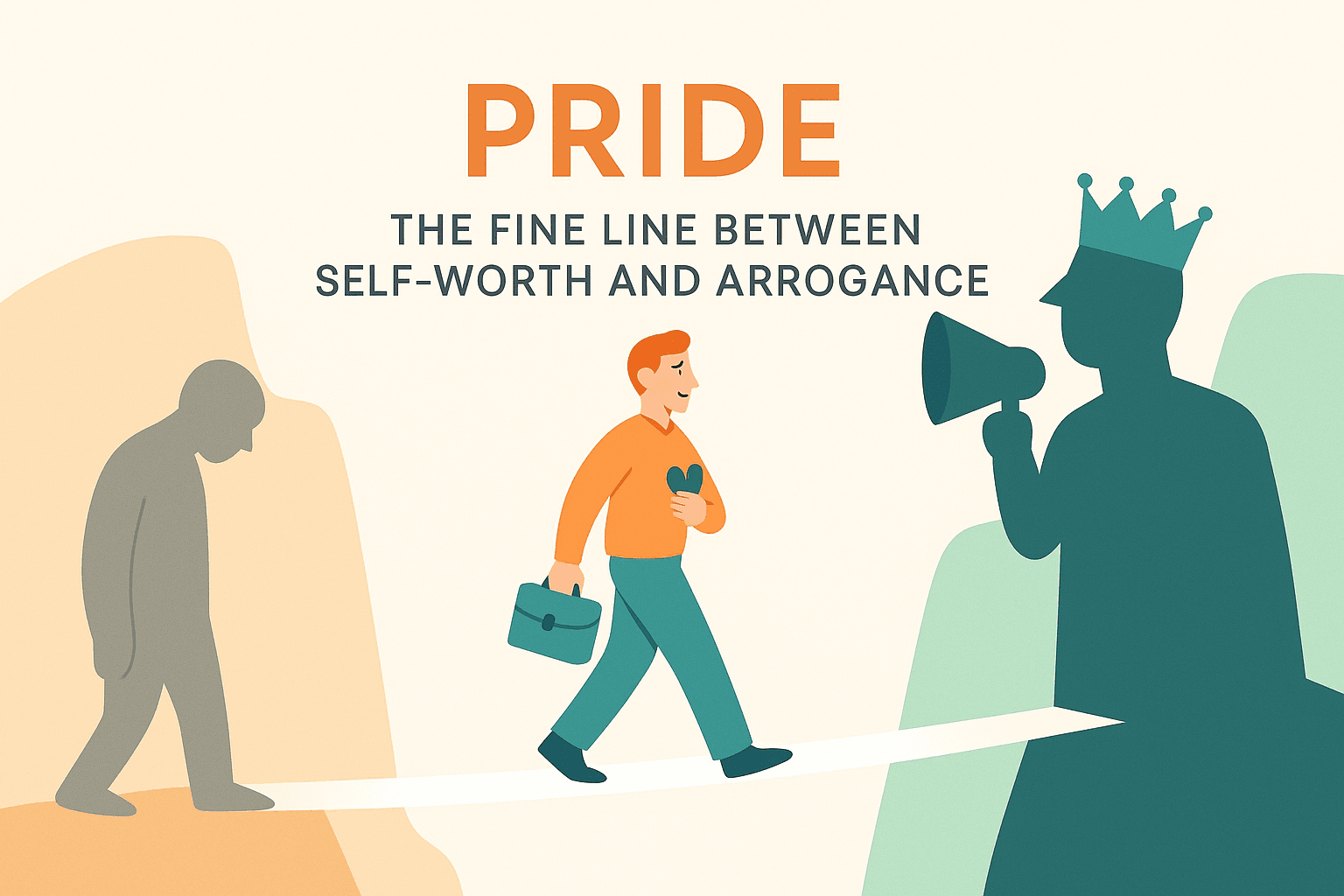
Table of contents:
Pride, without the peacock costume
It is self-respect with a memory
Healthy pride is not chest-thumping. It is not walking into a room like you personally invented fire, Wi-Fi, and good coffee. It is much more grounded than that. It is the sense that your effort counts, your standards count, and your achievements are allowed to belong to you.
A person with healthy pride does not need to pretend they are flawless. Thank God, because that sounds exhausting. They just stop erasing themselves every five minutes to keep everyone else comfortable.
There is memory in pride, too, and that part matters more than people think. You remember what something cost you. The late nights. The ugly first drafts. The awkward early attempts that made you want to crawl under a table. The stretch where you kept going while half-convinced you were embarrassing yourself in public. Pride lets you look at all that and say, yes, that mattered. Not because you are better than everyone else. Because your labor was real, and it changed something.
It shows up in standards, not just in feelings
People often talk about pride as if it were only an emotion, something warm and shiny you feel after doing well. In real life, though, it behaves more like a standard. It shapes how carefully you work, what kind of treatment you accept, how you speak about yourself, even how you finish the boring little things when nobody is watching.
A person with healthy pride tends to think, "If my name is on this, let it be decent." Not perfect. Decent. Solid. Something they do not need to hide behind a bush later.
That is why pride often has a quality streak in it. Not perfectionism - that can get brittle and weird in a hurry. More like self-respecting craftsmanship. You read the email once more before sending it. You do not hand in something lazy and then act shocked when it comes back bruised. You make the extra pass because it reflects you, and that matters.
That kind of care usually leans on responsibility too. Once you really take ownership of what carries your name, excuses get less glamorous. You stop hiding behind "well, technically..." and start asking, "Is this actually something I can stand behind?" Big difference. If that shift sounds obvious but turns slippery the moment something goes wrong, this guide on how to take responsibility can help make it more practical, especially when your first instinct is to explain, deflect, or quietly disappear.
It helps you keep your shape under pressure
Another piece of pride is dignity under strain. When things go sideways, people with some inner pride do not instantly tumble into "maybe I'm nothing, actually." They still feel embarrassed, annoyed, rattled - they're human, not teakettles carved from marble - but their sense of worth does not vanish on impact.
This matters in conflict, in setbacks, in negotiations, in heartbreak, at family dinners where someone says something a little too sharp and expects you to laugh it off for the sake of peace. You know the scene.
Pride gives a person ballast. It says, "I can take feedback without crawling under the furniture. I can lose without becoming small. I can be corrected and still remain intact." That lands very differently from vanity, which tends to shatter the second reality stops being flattering. Vanity needs mirrors. Pride can survive fluorescent lighting and bad news.
It is social too, whether we like it or not
Pride also has a public side. Your reputation. Your name. The quiet wish to be known for something solid. That does not mean living for applause, or turning your life into one long performance review. It just means understanding that identity is built, in part, through repeated action. People notice what you keep protecting. Quality. Honesty. Reliability. Courage. Warmth. Pick your lane.
And yes, a lot of us were taught to distrust pride altogether. "Don't get full of yourself." "Stay humble." "Don't brag." Fair enough. Those warnings were usually aimed at arrogance, not healthy self-respect. But plenty of adults swallowed the whole package and came away unable to feel good about their own progress without attaching a joke, a disclaimer, or a tiny self-insult at the end.
That is not humility. That is self-erasure in sensible shoes.
What gets better when pride grows up a little
You stop asking permission to value yourself
One of the biggest shifts happens inside. When pride gets healthier, your worth stops depending so completely on the room you happen to be standing in. Praise feels good, of course. Criticism can still sting, because you're not a houseplant. But neither one gets to rewrite your identity before lunch.
You become less desperate for outside confirmation and less crushed when it does not arrive. That changes behavior in very practical ways. You ask for fair pay with a steadier voice. You talk about your work without shrinking it into lint. You stop handing away credit like party favors just because visibility makes your skin itch.
Funny thing, too: once you genuinely believe your effort has value, other people often start treating it that way. Not always. People can be ridiculous. But often enough to notice.
Your work tends to get cleaner and stronger
Pride raises the floor, not only the ceiling. That's a useful distinction. A person with healthy pride is more likely to care about the ordinary details that build trust over time. They do not want their work to feel sloppy, their word to feel flimsy, or their name to become shorthand for "probably fine if no one looks too closely."
This usually improves performance without turning life into a grim self-optimization boot camp. You revise. You prepare. You follow through. Quietly, steadily. Even when no one is clapping and there is no dramatic soundtrack.
That is where discipline becomes such a useful sidekick. It turns good intentions into repeatable behavior instead of one heroic burst that disappears the moment your mood changes. And the engine underneath is different, too. Not panic. Not fear. Just the simple wish to be proud of what you put into the world.
Fear can make people sprint, sure. Pride helps them build something they do not want to disown later. Very different energy.
Boundaries become less theatrical
People with weak pride often struggle with boundaries in a sneaky, almost polite way. They say yes when they mean no. They laugh when they actually feel insulted. They tolerate chronic underestimation, then go home and simmer like a kettle no one switched off. Sound familiar?
Healthy pride makes boundaries feel less like some grand dramatic event and more like basic housekeeping. Not glamorous, just necessary.
You do not have to puff up or become icy. You simply stop cooperating with your own diminishment. You notice faster when a situation is asking you to betray your standards for convenience, approval, or false peace. That gets much easier with self-awareness, because once you can actually read your own patterns, you catch self-betrayal earlier instead of calling it politeness or flexibility. And because your self-respect has more weight now, saying "that doesn't work for me" stops sounding outrageous in your own ears.
Success becomes emotionally usable
This one gets missed all the time. Plenty of people achieve things and still cannot absorb them. They move the goalpost. They dismiss the result. They explain it away before the good feeling has time to land. "It wasn't a big deal." "Anyone could have done it." "I just got lucky." Efficient little system, really, if your goal is to stay perpetually hungry and oddly numb.
Healthy pride lets success register. You can enjoy what you built without becoming a show-off. You can let an achievement feed your confidence, your ambition, your willingness to try again. Emotionally, that changes a lot. Life stops feeling like a treadmill where effort vanishes through a trapdoor the second you do something well.
People sometimes call that "just being realistic," but a thin layer of cynicism toward your own effort can make every achievement feel suspicious. And when that happens, you lose the energy you would have carried into the next attempt.
With healthier pride, your wins become proof. Warm proof. The kind you can actually carry around on a bad day - and on bad days, honestly, that matters more than people admit.
When pride is underfed, life gets strangely smaller
You keep minimizing yourself in public and in private
Low pride often does not look dramatic. It looks pleasant. Self-deprecating. Easygoing. "Oh, it was nothing." "I just got lucky." "I'm not really that good." Cute for maybe thirty seconds. Then it starts chewing little holes in your life.
When you repeatedly downplay your abilities, your nervous system gets the memo too: do not stand fully in what you do well, do not take up too much space, do not let your success become visible. Over time, opportunities start sliding past. Not because you lack talent, but because you keep presenting yourself like the budget version.
And people, unfairly but predictably, often take you at your own valuation.
You tolerate scraps and call it being chill
Another cost is lowered standards. If pride is weak, you may accept work that does not reflect your ability, relationships that feel faintly disrespectful, environments that keep you small, or habits that quietly drag down your name. Then you explain it all away with very reasonable-sounding lines. "I'm flexible." "I'm low-maintenance." "It's fine."
Is it, though?
Underneath that so-called flexibility there is often resignation. A person stops expecting more because some part of them no longer believes they should. That is where low pride starts to injure dignity. You get used to what is beneath you, then wonder why resentment keeps stomping around the house in muddy shoes.
Your motivation gets weirdly dependent on applause
Without inner pride, motivation often becomes borrowed. You work hard when someone notices. You feel valuable when someone approves. You light up when there is recognition, then sag like a paper lantern when there is none. Exhausting way to live, if we're honest.
This creates a fragile kind of ambition. From the outside, you may look driven. Inside, a lot of that drive is held together by the hope that somebody - finally, please - will confirm that you are worth taking seriously.
The problem is that outside validation is wildly inconsistent. People are busy. Distracted. Stingy sometimes. Weird about praise. If your sense of value lives entirely in their hands, your self-respect gets yanked around like a shopping cart with one bad wheel. Lots of movement, not much grace.
Shame sneaks in through the back door
Low pride has an emotional cost people do not always name clearly. Shame grows in the gap between what you know you are capable of and how little you allow yourself to claim. You feel it after the meeting where you stayed tiny. After the compliment you batted away. After producing good work and then talking about it like you found it in a parking lot. If that feels familiar, it may help to look more closely at how shame quietly warps a life, because it often hides inside self-protection and modesty long before you realize how much space it is taking up.
Then there is the social side. When people sense that you do not back your own value, some of them push harder. Not everyone, obviously. But enough. They interrupt more easily, offer less, assume you will bend, forget to credit you, or treat your effort as endlessly available.
By the time you really notice the pattern, you may feel oddly invisible and oddly angry at once. Miserable combination. Also a clue. Pride is not vanity's cousin here - it is protection.
How to build healthy pride without becoming obnoxious
Keep an evidence file, not a fantasy file
Start with facts. Write down ten things you are genuinely proud of, but do not make them shiny and vague. Name what you did, what made it hard, and what quality in you helped it happen.
Maybe you rebuilt your finances after a rough year. Maybe you spoke in public even though the first few attempts felt like slow-motion death. Maybe you kept a promise when disappearing would have been easier. Maybe you handled a brutal conversation with more honesty than your old self could have managed. Count that stuff.
This matters because low pride often survives on selective memory. The mind remembers embarrassments in ultra HD and stores achievements in a dusty basement box labeled "probably irrelevant." An evidence file corrects that. Not by flattering you. By reminding you what is actually true.
Practice saying one win without apologizing for it
Pick one thing you are proud of and tell one safe person about it plainly. No joke at the end. No "it's probably not a big deal." No immediate pivot to your flaws, your luck, your timing, your hair that day. Just the win, out loud.
If that makes you squirm a little - well, there we are. Useful information.
A lot of people were never taught how to own success in a clean sentence. They either hide it or oversell it. But there is a middle ground, and it sounds wonderfully normal. "I handled that project really well." "I'm proud of how I dealt with that conversation." "I worked hard for this promotion."
Simple. Adult. Slightly terrifying, maybe. Very useful.
Make your progress visible to your own eyes
Create some visible reminder of your earned progress and put it somewhere you will actually see it. Not in a folder called FINAL_v2_REAL_FINAL buried on your laptop - we both know that folder is basically a graveyard. Put it on the wall, by your desk, inside a notebook you open every day.
Photos, milestones, notes from clients, screenshots, before-and-after snapshots, a sentence you wrote down after doing something brave. Whatever feels real to you.
This is not a shrine to yourself, relax. It is a counterweight to the brain's habit of treating your progress as temporary, accidental, or somehow not fully yours. Visible evidence helps pride become more physical, more believable.
And for people whose progress gets lost in mental clutter, a bit more structure can help self-respect feel less abstract. What you can see and organize is much easier to trust. You stop relating to your growth like it's just a rumor.
Find out what your name already carries
Ask three people how they would describe your reputation. Keep the question clean: "When you think of me professionally or personally, what qualities come to mind?" Then write down the answers exactly as they say them. No arguing. No modest little interruptions. And no fishing for compliments either - people can smell that from orbit.
Then look for the pattern. Reliable? Thoughtful? Sharp? Calm under pressure? Or maybe talented but inconsistent, warm but hard to read, creative but scattered. This is useful gold.
Healthy pride is not blind admiration of yourself. It is an honest relationship with the name you are building. Once you can see that more clearly, you can strengthen it on purpose instead of just hoping it all works out somehow.
Do one thing tonight that makes you respect yourself more
Not someday. Tonight.
Choose one behavior that affects your self-respect and improve it for the next three days in a row. Finish the thing you said you would finish. Reply with more care. Prepare properly. Clean up the corner you have been handling sloppily. Or share one achievement publicly - a short post, a brief update, a few honest lines about what you learned.
If someone's recognition genuinely shaped your confidence, thank them directly. That matters too. Pride grows not only through private effort but also through being witnessed well, and letting that witness count instead of shrugging it off.
Bit by bit, the message changes: I do things I can stand behind. I let myself know it. Sometimes I let other people know it too, when it is true. That is not arrogance. That is self-respect finally getting a microphone.
Is pride the thing to work on now?
Not always. Some people truly do need stronger pride. Others already have plenty of self-focus and would benefit more from humility, emotional regulation, or the ability to hear feedback without turning into a board with shoulders. It happens.
Sometimes the real issue sits closer to arrogance than undernourished pride. In that case, the task is not to inflate yourself further. It is to get grounded enough to learn, to listen, to stay open without collapsing or trying to dominate the room. Context matters. Timing does too.
It helps to notice your actual pattern instead of choosing the trait that merely sounds noble. If your main struggle is chronic self-erasure, weak boundaries, discomfort around your own success, or the habit of making yourself smaller so other people stay comfortable, then yes - pride probably deserves some attention. And sometimes the heaviness underneath is less about pride itself and more about when life stops feeling like it belongs to you, because it is hard to respect your direction when you no longer feel connected to it.
If you are running on exhaustion, shame, or constant anxiety, start there first. If your mind keeps rehearsing worst-case scenarios like it is being paid by the hour, working on anxiety and overthinking first can give pride a fairer shot. If exhaustion is coming less from your workload and more from late-night attempts to reclaim a little freedom, it may help to ask whether revenge bedtime procrastination is the thing to work on right now, because sleep deprivation can make self-respect feel much shakier than it really is. It is hard to stand tall while your brain keeps pulling the fire alarm. Otherwise you end up polishing the wrong part of the machine and wondering why it still rattles.
If you want a clearer read on what matters most right now, AI Coach can help you sort your priorities and sketch out a simple plan for the first three days. Sometimes the most helpful move is not "fix everything." It is "oh, this first."
Frequently Asked Questions (FAQ)
What is healthy pride in simple terms?
Healthy pride is a grounded sense of self-respect tied to real effort, values, and earned results. It helps you recognize what you have done well, protect your standards, and let success actually land instead of brushing it off like lint from your sleeve.
Is pride a good thing or a bad thing?
It can go either way. Healthy pride supports dignity, quality, and resilience. Unhealthy pride turns into arrogance, defensiveness, or the need to feel superior. Usually the difference comes down to whether your pride is rooted in reality and self-respect, or in ego panic wearing nice shoes.
What is the difference between pride and arrogance?
Pride says, "I value what I have earned, and I do not need to shrink." Arrogance says, "I need to feel above you." Healthy pride leaves room for other people's worth. Arrogance competes with it. One has backbone. The other needs an audience and maybe better coping skills.
How do I know if I lack pride?
Look for patterns like minimizing your achievements, feeling awkward when praised, accepting less than you know is fair, struggling to speak about your strengths, or needing constant approval to stay motivated. Low pride often disguises itself as modesty, humor, or very practiced "it's fine" energy.
Can pride improve confidence?
Yes, often quite a lot. Confidence is easier to build when you can actually absorb your wins and respect your own effort. Pride gives confidence something solid to stand on. Without that, confidence can turn into all pep talk and no floorboards.
Why do compliments make me uncomfortable if I secretly want recognition?
Because wanting recognition and being able to receive it are not the same skill. Plenty of people were taught that accepting praise is boastful, selfish, risky, or somehow embarrassing. So the nervous system reaches for deflection even while another part of you is starving for acknowledgment. Annoying little split, that.
Can too much pride become a problem?
Absolutely. When pride gets rigid, it can make people defensive, hard to teach, or unable to admit mistakes without feeling shattered. Healthy pride can handle correction. Inflated pride hears one suggestion and starts preparing a courtroom speech.
Does pride matter in relationships, or is it mainly a work thing?
It matters everywhere. In relationships, healthy pride helps you keep your dignity, ask for respectful treatment, and avoid disappearing into people-pleasing. It also helps you repair conflict without groveling or pretending you have no needs. Very practical. Not just a work thing at all.
How does childhood or culture affect pride?
A lot. Some families and cultures encourage achievement but distrust visible self-respect. Others praise confidence loudly but tie worth too tightly to performance. Many adults learned to confuse pride with vanity, so they keep themselves smaller than necessary in order to stay "good." Those old messages linger until you look at them on purpose.
What is one small daily habit that strengthens pride?
At the end of the day, write down one thing you handled well and why it reflects something solid in you - discipline, kindness, courage, precision, honesty, whatever fits. Keep it factual, not sugary. Over time, this trains your mind to notice earned value instead of only tracking flaws, stumbles, and unfinished business. Small habit. Quietly powerful.